In just over a year, the organization has moved from formation to action—creating technical programs, institutional partnerships and a growing network for Filipino engineers across the Emirates.
DUBAI, United Arab Emirates — Professional organizations are often measured by the number of events they conduct. Their real value, however is found in the opportunities they create, the people they connect and the direction they give to a profession.
For the Philippine Institute of Industrial Engineers–UAE Chapter, its first year was not simply about establishing a new organization. It was about creating a professional home for Filipino Industrial Engineers working far from the Philippines and across some of the UAE’s most demanding industries.
From manufacturing floors and construction projects to aviation, logistics, quality management, technology and business operations, Filipino Industrial Engineers have long contributed to the UAE’s development. Yet many of them have pursued their careers without a dedicated local platform that could bring their experiences, expertise and ambitions together.
PIIE-UAE Chapter was formed to help fill that gap.
Its journey from formal inauguration to technical training, government collaboration and its first anniversary reflects a broader story about Filipino professionals abroad: the desire not only to succeed individually but also to build institutions that allow others to grow.
A Chapter Born from a Shared Need
The chapter was formally inaugurated on March 26, 2025 at the Philippine Embassy in Abu Dhabi in the presence of Philippine Ambassador to the UAE H.E. Alfonso Ferdinand Ver. The oath-taking marked the beginning of the organization’s public journey but the significance of the moment went beyond ceremony. It represented recognition that Filipino Industrial Engineers in the UAE needed a unified voice, a credible professional network and a platform that could respond to the realities of working abroad.
Industrial Engineering is one of the broadest engineering disciplines. Its practitioners improve systems by studying how people, processes, materials, information and technology interact.
In the UAE, Filipino Industrial Engineers may be found in production planning, supply chain, quality assurance, project management, operations, aviation, healthcare, logistics, construction, data analysis and organizational improvement. Their roles may differ but their professional foundation remains the same: making systems safer, smarter, faster and more efficient.
PIIE-UAE Chapter set out to connect these professionals across sectors and emirates. Its mission is centered on professional growth, knowledge sharing and community engagement. Its vision is to become a leading organization for Filipino Industrial Engineers in the UAE, recognized for its contribution to professional development and industry practice. But mission and vision statements only gain meaning when they are translated into action. That became the chapter’s defining test during its first year.
Building Before Being Seen
Much of the work involved in establishing a professional organization happens away from the public eye. Meetings, policies, documentation, partnerships, membership systems and leadership structures rarely receive the same attention as major events. Yet these are the foundations upon which credible institutions are built. Following the inauguration, the chapter’s founding members and officers worked to define its structure and priorities. An organizational meeting in April 2025 focused on leadership appointments and future direction. A later planning session in Dubai addressed governance documents and preparations for deeper engagement with PIIE National. These early activities may appear administrative, but they were critical.
A professional chapter cannot rely solely on enthusiasm. It must develop systems that can survive beyond its founding officers, maintain accountability and earn the confidence of members and partners. The chapter’s formal recognition by PIIE National in May 2025 strengthened that foundation.
Through the signing of institutional agreements, the UAE Chapter became part of a wider professional network connecting Filipino Industrial Engineers in the Philippines and overseas. That recognition gave the chapter not only legitimacy but also responsibility. It was no longer simply a group of professionals organizing activities. It was becoming an institution expected to represent the profession with integrity.
Moving from Organization to Professional Impact
The chapter’s early direction became clearer through the type of learning programs it chose to deliver. Rather than limiting its activities to social gatherings or ceremonial functions, PIIE-UAE Chapter introduced training in areas that respond to the changing demands of modern industry.
Its programs covered statistical analysis, Lean Six Sigma, data analytics, artificial intelligence, UI/UX design and website development. This combination is significant. It reflects an understanding that Industrial Engineering is no longer confined to traditional production studies or factory systems. Today’s Industrial Engineers are increasingly involved in digital transformation, automation, business intelligence, customer experience, sustainability and technology-enabled operations.
The chapter’s training portfolio therefore presented a broader message: Filipino Industrial Engineers must preserve their analytical foundation while expanding their digital capabilities.
Turning Data into Better Decisions
One of the chapter’s major technical initiatives was the two-session Data Analytics for Engineers program conducted in October 2025. Facilitated by Dr. Raiza Dimapilis Borreo, the training introduced participants to the practical role of data in engineering decision-making. The subject was timely. Organizations now generate vast amounts of information but data has little value unless professionals can interpret it, question it and convert it into action. Participants were introduced to descriptive, diagnostic, predictive and prescriptive analytics—the progression from understanding what happened to deciding what should be done next.
The program also demonstrated the use of Tableau for visualization and dashboards, followed by practical applications of Python and Pandas for data preparation and analysis. These were not merely software lessons. For Industrial Engineers, data analytics can shape decisions involving production output, inventory, demand, process variation, service performance, maintenance, quality and capacity. A poorly designed analysis can lead to the wrong conclusion. A well-structured one can reveal waste, risk and opportunity that would otherwise remain hidden.
By introducing these capabilities, the chapter was helping members move beyond intuition toward more disciplined, evidence-based decision-making.
Artificial Intelligence with a Filipino Community Purpose
The chapter’s collaboration with Project PINAI—Personal Intelligence for Filipinos in AI expanded this digital agenda. Founded by Dr. Raiza Dimapilis Borreo, Project PINAI was created to make artificial intelligence more understandable and accessible to Filipinos in the UAE. The partnership reflected a practical concern.
Artificial intelligence is often discussed in ways that are either overly technical or unnecessarily alarming. Many professionals understand that AI will affect their work, but not all have access to reliable guidance on how to use it responsibly. Through lectures supported by the Philippine Embassy and PIIE-UAE Chapter, participants were introduced to the applications, opportunities and limitations of AI.
For Industrial Engineers, the technology may support forecasting, scheduling, quality inspection, process monitoring, predictive maintenance and workflow automation. Yet the most important lesson was not that AI could replace professional work. It was that professionals must learn how to use emerging tools without surrendering judgment, accountability or ethical responsibility.
The chapter’s role in this initiative showed that professional development is not only about teaching technical skills. It is also about helping people respond intelligently to change.
Returning to the Core: Statistics and Process Improvement
While the chapter expanded into emerging technology, it also remained grounded in the core disciplines of Industrial Engineering.
In January 2026, Mr. Eliazar R. Dimalapang, widely known among participants as Sir Elizar, facilitated two Industrial Engineering Statistical Methods Workshops. The first was held at the Philippine Embassy in Abu Dhabi, while the second took place at the Philippine Consulate General in Dubai.
The sessions emphasized the practical use of statistics in process analysis, performance measurement and Lean Six Sigma projects.
Statistics is sometimes viewed as a difficult academic requirement. In professional practice, however, it is one of the most important tools for separating facts from assumptions. A process may appear to be improving when it is only experiencing temporary variation. A suspected root cause may seem convincing but fail when tested against evidence.
Statistical thinking helps professionals ask better questions.
Is the process stable?
Is the variation normal or exceptional?
Did the solution create a genuine improvement?
Can the result be sustained?
By conducting the workshops in both Abu Dhabi and Dubai, the chapter also demonstrated a practical commitment to accessibility.
Filipino professionals in the UAE work long hours, often across distant emirates. Bringing learning opportunities closer to different communities made participation more realistic. The support of the Philippine Embassy and Philippine Consulate General was therefore more than institutional courtesy. It helped make professional education available to a wider audience.
Designing Better Digital Experiences
The chapter’s February 2026 training on Practical UI/UX Design, Website Development and Deployment further demonstrated the expanding role of Industrial Engineers. The first session was facilitated by Mr. Pedro Flores, who introduced participants to User Interface and User Experience design. At first glance, UI/UX may appear distant from Industrial Engineering. In practice, the disciplines share a common purpose.
Both begin with the user.
Both examine how people interact with a system.
Both seek to eliminate confusion, unnecessary steps and failure points.
A visually attractive platform may still be ineffective if users cannot understand it. A technically complete system may still fail if it does not reflect the needs of the people expected to use it. Through Figma and Justinmind, participants learned how wireframes and prototypes can help teams visualize ideas, test user flows and identify problems before full development begins. The training gave Industrial Engineers another way to apply systems thinking—this time within digital environments. These skills can be valuable in designing dashboards, mobile applications, membership systems, online portals and internal business tools.
From Design to Deployment
The second portion of the program was led by Dr. Sufian Bin Idris, who guided participants through website development using WordPress and deployment through InfinityFree. The session completed the practical journey from concept to execution. Participants were introduced to website structure, navigation, content, themes, plugins, functionality and publishing. More importantly, they saw how different disciplines connect. A website begins with a purpose.
It requires an understanding of its audience.
Its content must be organized logically.
Its design must support the user.
Its technical build must be reliable.
Its deployment must make it accessible.
This is precisely the kind of integrated thinking that Industrial Engineering encourages. The training was not intended to turn every participant into a professional web developer. It was designed to help engineers understand the development process so they could contribute more effectively to digital projects, collaborate with technical teams and transform ideas into working solutions.
Learning from Industry Beyond the Classroom
The chapter also broadened its members’ industry exposure through engagement connected with Dubai Airshow 2025. Aviation and aerospace may appear highly specialized but they rely extensively on Industrial Engineering principles. Aircraft maintenance, ground operations, passenger movement, safety systems, logistics, inventory, scheduling, quality assurance and operational readiness all require the coordination of complex resources.
For Filipino Industrial Engineers, exposure to an international event of this scale provided a view of how automation, artificial intelligence, advanced manufacturing and sustainability are reshaping one of the UAE’s most strategic industries. It also reinforced an important professional truth: Industrial Engineering is not limited by sector. Its value lies in the ability to understand systems and improve how they perform.
The People Who Shared Their Expertise
The chapter’s professional programs were strengthened by individuals who contributed their knowledge to the community.
Dr. Raiza Dimapilis Borreo brought expertise in data analytics and artificial intelligence.
Mr. Eliazar R. Dimalapang reinforced the importance of statistical methods and data-driven improvement.
Mr. Pedro Flores introduced participants to user-centred digital design.
Dr. Sufian Bin Idris guided them through website development and deployment.
Their contributions represented more than technical instruction. They demonstrated the value of professional volunteerism experienced individuals sharing practical knowledge with fellow Filipinos so that the wider community can progress. This culture of knowledge sharing may ultimately become one of the chapter’s most important achievements.
Organizations grow stronger when expertise is not guarded but passed forward.
A First Anniversary with a Larger Meaning
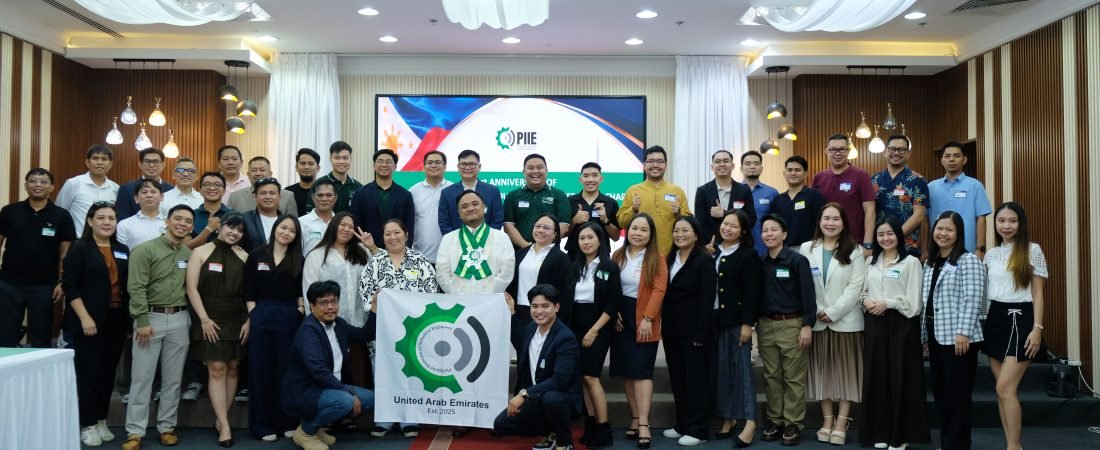
The chapter’s first anniversary was held on July 11, 2026, at JTI Events, Waterview Residence in Port Saeed, Deira, Dubai. The theme, “The Journey That Shaped Us, The Vision That Drives Us,” reflected both gratitude and ambition. The gathering recognized the organization’s early milestones, but it also acknowledged the work still ahead. Its first year had established a foundation.
The next challenge would be to deepen its impact. The event welcomed members, new inductees, guests and professional partners. It also invited Filipino Industrial Engineers who had not yet joined the chapter to learn more about its purpose and become part of the growing community. That invitation was important. Professional organizations cannot remain relevant by serving only those already inside them. They must continue reaching graduates, mid-career professionals, senior leaders and Industrial Engineers who may be working outside traditional engineering roles.
Four Voices of Professional Experience
The anniversary program featured four speakers whose careers reflected the breadth of Industrial Engineering and related disciplines.
Engr. Aristotle Santos shared perspectives shaped by experience in planning, manufacturing, systems and organizational development.
His professional journey highlighted the importance of adaptability and strategic thinking in industries undergoing continuous change.
Engr. Jerry Timbas brought insights from quality assurance, compliance, auditing and continuous improvement. His message reinforced the idea that quality is not a department or a checklist. It is a culture that must be supported by leadership, discipline and accountability.
Engr. Chris Cuevas shared lessons from international engineering, commissioning and project delivery. His career reflected the value of technical competence, professional discipline and readiness to operate across different cultures and industries.
Engr. Jose Florante Jr. Agno offered perspectives from manufacturing, operations, production planning, logistics and process improvement. His experience demonstrated how Industrial Engineering principles can directly influence productivity, reliability and business performance.
Together, the speakers offered more than career stories. They presented different examples of how Filipino engineers can lead, adapt and create value across industries.
Recognition Beyond the Chapter
The anniversary also featured messages from Scott Sink, former president of the Institute of Industrial and Systems Engineers and Mohamed M. Korym, General Manager of the Society of Engineers UAE. Their participation reflected the chapter’s growing connection with the wider engineering community. International recognition is meaningful but it also carries expectations.
As the chapter develops, it will need to ensure that its programs remain credible, relevant and aligned with both local industry needs and international professional standards.
The Work Behind the Milestones
Every public milestone was supported by work that was rarely visible. Officers and volunteers handled registration, logistics, documentation, coordination, communications, partnerships, event preparation and member support. Most completed these responsibilities while managing full-time careers and family obligations. Their contribution deserves emphasis because professional communities do not grow through speeches alone.
They grow through consistent work.
They grow when people attend meetings after office hours.
They grow when volunteers respond to inquiries, prepare materials, secure venues and support participants.
They grow when leadership becomes service rather than title.
The chapter’s first year was therefore not only a record of events. It was evidence of collective effort.
An Invitation to Filipino Industrial Engineers
As PIIE-UAE Chapter enters its next phase, it is extending its reach to Filipino Industrial Engineers across Abu Dhabi, Dubai, Sharjah, Ajman, Ras Al Khaimah, Umm Al Quwain, Fujairah and Al Ain.
The invitation is open to fresh graduates, experienced professionals, analysts, quality specialists, operations leaders, educators, project managers, entrepreneurs and Industrial Engineering graduates who may now be working in other fields. Joining a professional organization should not be viewed merely as obtaining a membership card or attending an event. Its real value lies in access to people, ideas, mentorship and opportunities for contribution. A strong professional community allows members to learn from one another.
It gives younger professionals role models.
It gives experienced practitioners a place to share.
It gives the profession a stronger collective voice.
The Next Chapter
The first year of PIIE-UAE Chapter established its presence. The years ahead will determine its legacy. Its future success will depend on whether it can sustain effective governance, maintain credible programs, build stronger industry partnerships and continue reaching Filipino Industrial Engineers across the UAE. It must also ensure that professional development remains practical, inclusive and responsive to the changing workplace.
The organization has already shown its willingness to combine established Industrial Engineering disciplines with emerging areas such as artificial intelligence, data analytics and digital design. That balance will remain essential. The profession must evolve without losing its foundation.
The chapter must grow without losing its purpose. And its leaders must continue remembering that the strength of a professional organization is measured not by the prominence of its officers, but by the growth of the people it serves.
PIIE-UAE Chapter’s first year was a beginning. Its deeper story will be written through the professionals it empowers, the partnerships it builds and the contribution it makes to Filipino Industrial Engineers in the UAE. The journey has shaped the chapter. The vision must now shape its future.